The process
What is in an electroless nickel bath, and how a surface is activated
An electroless nickel bath is a nickel salt, a reducing agent, a set of additives and water, and every additive buys something at a price. None of it works until the surface has been cleaned and given a metal that can start the reaction.
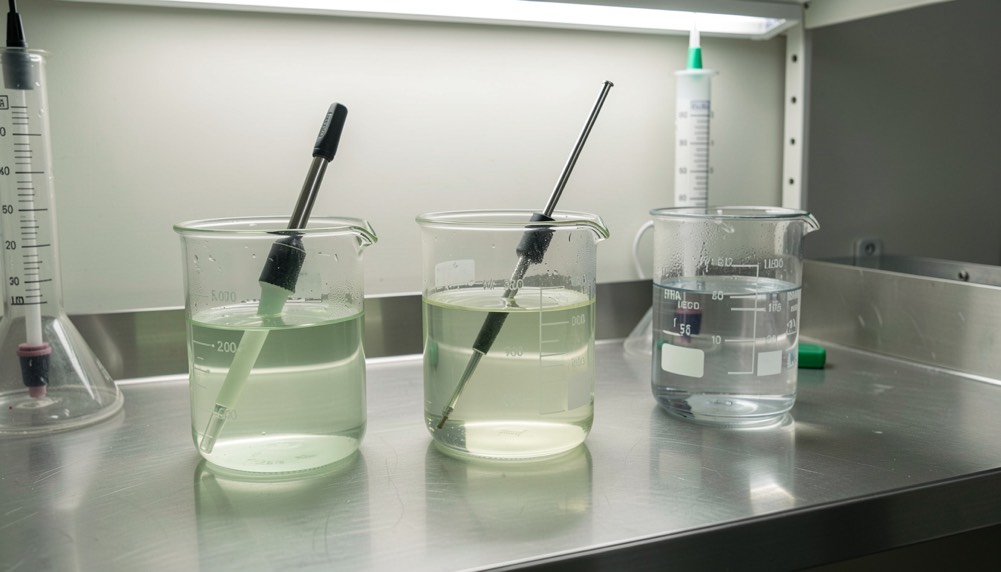
An electroless nickel bath is a bargain written in chemistry. Nickel reaches the surface because a reducing agent hands it electrons, and everything else in the tank exists to keep that exchange slow, even and controlled. This note covers the two reagents, the byproducts the reaction leaves, six additive families and what each costs, and the activation routes that decide whether a deposit starts.
Nickel sulfate and hypophosphite carry the load
Two reagents do the work. The nickel source is usually nickel sulfate. The reducing agent is usually a hypophosphite salt, which is also where the phosphorus in the alloy comes from; the alternative is a borohydride bath, which yields a nickel-boron coating and is out of scope here. Both dissolve in water, and the part is simply dipped: no rectifier, no anodes, no current to distribute. What the deposit itself does, and what its phosphorus content does to it, is the subject of the process note.
What the reduction leaves behind
Written out, the main reaction balances eight hypophosphite ions against two nickel cations, as the electroless nickel-phosphorus plating article sets it out:
2 Ni2+ + 8 H2PO2- + 2 H2O → 2 Ni0 + 6 H2PO3- + 2 H+ + 2 P + 3 H2
The right-hand side is why a bath needs managing. Orthophosphite is a byproduct and accumulates in solution. Elemental phosphorus co-deposits with the nickel, which makes the deposit an alloy rather than a pure metal. Protons drive the bath toward acidity, which buffers exist to hold. Hydrogen leaves as gas. Cobalt, palladium, rhodium and nickel itself all catalyze the reaction, and nickel on that list is what makes the process autocatalytic: once an initial layer has formed, the reaction continues on its own, with no external current. That evenness is why recesses and blind holes are the classic case; why electroless nickel coats a blind hole and electroplating does not takes the comparison apart.
Six additive families, each with a bill
A production bath carries six families of additives around those two reagents:
- Complexing agents, typically carboxylic acids or amines, raise phosphate solubility and prevent the white-out phenomenon by slowing the reaction.
- Stabilizers, such as lead salts, sulfur compounds or various organic compounds, slow the reduction by co-depositing with the nickel.
- Buffers hold the bath’s acidity steady, and many complexing agents do that job too.
- Brighteners, such as cadmium salts or certain organic compounds, improve the finish and are mostly co-deposited.
- Surfactants keep the deposited layer hydrophilic, which reduces pitting and staining.
- Accelerators, often sulfur compounds, recover the rate that complexing agents cost, and because they co-deposit they may discolor the coating.
Nothing on that list is free: complexants slow the bath, accelerators undo the slowing, and stabilizers, brighteners and accelerators all end up inside the deposit. Lead and cadmium are the heavy-metal entries, and the same reference notes that automotive applications accept only End of Life Vehicles Directive or RoHS compliant process types, free from heavy metal stabilizers.
What must a surface be before it can start the reaction?
Activation sets two conditions, and the bath supplies neither. The surface must be hydrophilic, and it must consist of a metal with catalytic activity for the reaction; if the substrate is not one of those metals, a thin layer of one has to be deposited first by some other process. Both conditions begin with cleaning, and cleaning is a sequence: non-polar solvents lift oils and greases, acids and alkalis strip oxides, insoluble organics and other contaminants, and the part is rinsed after every bath so that no cleaning chemical carries over. ASTM B322, the standard guide to cleaning metals before electroplating, describes the same family of steps. One caution: internal stresses left in the substrate by machining or welding can affect the plating, and no rinse removes them.
Iron and aluminum start themselves; copper needs zinc
Substrates more electropositive than nickel, such as iron and aluminum, need no help: an initial nickel film forms spontaneously by a redox reaction with the bath. Metals less electropositive than nickel, such as copper, cannot do that. Their remedy is a piece of a more electropositive metal, such as zinc, immersed and electrically connected to the part, which forms a shorted galvanic cell and lays down the first nickel. The reference gives no time and no thickness for that step. Once it is done, the surface presents nickel to the bath, and nickel catalyzes its own deposition.
How does a plastic part get a catalytic surface?
Graphite conducts but is not a metal, and its initial layer can be created by briefly running a current through it and the bath, as in electroplating; the reference marks that route as needing a citation. Plastics such as ABS are neither conductive nor metallic, and they take an activating bath holding a noble metal salt, such as palladium chloride or silver nitrate, with a suitable reducing agent; the page flags it the same way. For non-metallic substrates generally, activation is done with a weak acid etch, a nickel strike, or a proprietary solution. Strike is a precise word: a very thin initial deposit, typically less than 0.1 µm thick, laid down for quality and adhesion before real thickness is built.
After the bath, and what the bath costs
Plating is not the last step. An anti-oxidation or anti-tarnish chemical coating, such as phosphate or chromate, follows, then a rinse and drying to prevent staining. Baking may be necessary, to improve hardness and adhesion, anneal internal stresses and expel hydrogen that can embrittle the deposit; what a post-plate bake changes is the subject of Hardness and post-plate baking. The running cost is chemical: reagents are consumed in proportion to the mass of nickel deposited, where an electroplating bath replenishes its nickel from a metallic anode, so automatic mechanisms may be needed to feed reagents in during plating. The public reference publishes no bath temperature, no pH window and no deposition rate.
One check needs no equipment. Rinse a prepared part and hold it vertical: clean, hydrophilic metal holds an unbroken sheet of water, while oil beads and drains away. The electroplating reference calls this the waterbreak test, describes a version of it in ASTM F22, and warns that surfactant residues cut its sensitivity. Hydrophilicity is the first of the two activation conditions, so it is the first thing to check before a rack enters the tank.
Source card: electroless nickel-phosphorus plating on Wikipedia
- The public encyclopedia article on the nickel-phosphorus variant of electroless nickel plating, the version usually meant by the short name EN plating.
- It carries bath chemistry, additive families, cleaning and activation, after-plating treatment, composites by codeposition, properties, applications, and a standards list from AMS-C-26074 and ASTM B-733 to MIL-DTL-32119 and IPC-4552 for ENIG.
- Several of its property figures are flagged on the page itself as needing citations.
What is in an electroless nickel bath, and how a surface is activated: the 2 sources used
- Electroless nickel-phosphorus plating - Wikipedia · https://en.wikipedia.org/wiki/Electroless_nickel-phosphorus_plating
- Electroplating - Wikipedia · https://en.wikipedia.org/wiki/Electroplating