Properties and testing
Hydrogen embrittlement and relief baking
Hydrogen embrittlement needs two ingredients at once, diffusible hydrogen and stress, and it hits high-strength steels hardest. This note gives the threshold values, the temperature window, and what baking after plating actually does.
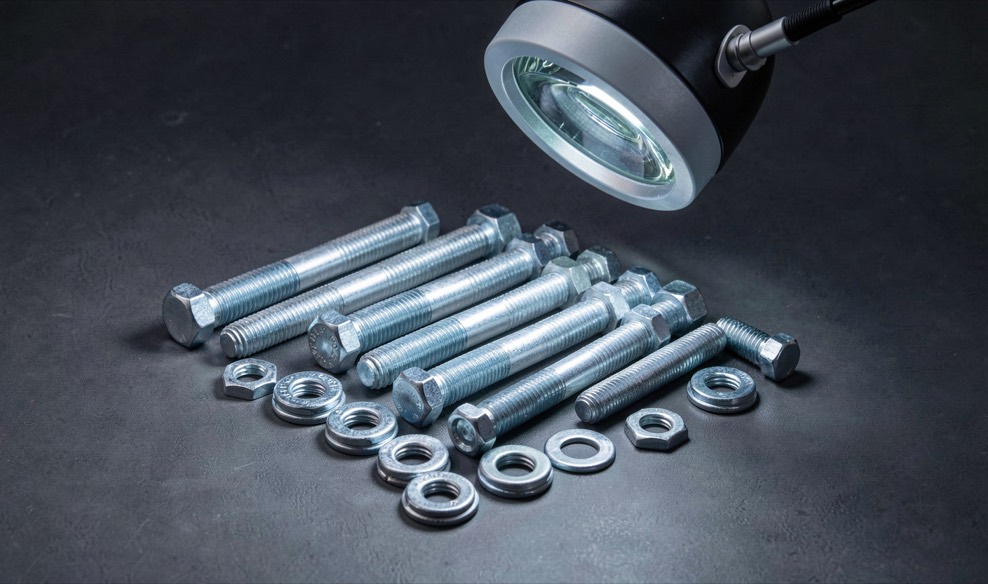
Hydrogen embrittlement is a reduction in the ductility of a metal caused by absorbed hydrogen. The hydrogen atoms are small enough to permeate solid metals, and once inside they lower the stress required for cracks to initiate and propagate. For anyone specifying an autocatalytic nickel bath, that matters because plating, along with pickling, etching and cleaning, is one of the electrochemical processes that generate atomic hydrogen at the metal surface, where it dissolves quickly into the part at room temperature. The essential facts have been known since the 19th century, and the public record on them is stable enough to quote with confidence.
Two ingredients, or nothing happens
The mechanism is unusually clear about its preconditions. Embrittlement requires both atomic, diffusible hydrogen and a mechanical stress to drive crack growth, and the stress can be applied or residual. Remove either one and the failure mode does not develop. That is why a perfectly plated part can sit quietly on a shelf for years, then crack weeks to decades after being tensioned in service, as hydrogen keeps accumulating from cathodic protection and other sources. Strain rate matters too: embrittlement increases at lower strain rates, which is one reason a quick pull test can pass a part that a slow-loaded one would break. The source reference on hydrogen embrittlement states these conditions plainly, and it also notes that the mechanisms in steels are not comprehensively understood and remain under investigation.
Where the temperature window sits
Temperature narrows the problem considerably. In steels, embrittlement is maximized at around room temperature, and most metals are relatively immune above 150 °C. That bracket, roughly ambient to 150 °C, is where a finished part actually lives and where a plating line operates, which is why the phenomenon follows the coating industry so closely. It should not be confused with high temperature hydrogen attack, a separate degradation of steels above 204 °C involving the formation of methane pockets. A part that embrittles in service failed inside the low-temperature window, not outside it.
How hard is too hard?
Susceptibility tracks strength. Higher-strength steels are more susceptible than mid-strength steels, and as strength rises, fracture toughness falls, so the likelihood that hydrogen will lead to fracture rises with it. The numbers the public reference gives are these: steel below an ultimate tensile strength of 1000 MPa, about 145,000 psi, or below HRC 32 on the Rockwell C scale is not generally considered highly susceptible. Anything above HRC 32 may be susceptible to early hydrogen cracking after plating processes that introduce hydrogen. Failures have been reported in the HRC 32 to 36 range and above, and parts in that range are often checked during quality control. One measured example shows the stakes: 17-4PH precipitation-hardened stainless steel saw its elongation at failure drop from 17% to 1.7% when smooth specimens were exposed to high-pressure hydrogen.
| Quantity | Value | Condition given by the source |
|---|---|---|
| Tensile strength below which steel is not generally considered highly susceptible | 1000 MPa (~145,000 psi) | Ultimate tensile strength |
| Hardness threshold | HRC 32 | Rockwell C scale |
| Reported failure range | HRC 32–36 and above | The reference marks this value as needing a source |
| Temperature above which most metals are relatively immune | 150 °C | Most metals |
| High temperature hydrogen attack threshold | above 204 °C | Steels, methane pocket formation |
The 17-4PH figures are from a NASA-reviewed compilation, not from a plating shop, and the table above is worth keeping beside a drawing before hardness is specified.
Where the hydrogen in plating comes from
A plating line is a hydrogen factory. In an electroless nickel-phosphorus bath, the main deposition reaction itself yields molecular hydrogen gas as a product, and the broader finishing sequence around it, acid pickling, etching and cleaning, adds electrochemical sources of hydrogen at the surface. The Wikipedia article on the plating process notes that baking after plating may be necessary to expel trapped hydrogen that may make the coating brittle, alongside its roles in hardness and adhesion. The embrittlement page agrees from the other side: the most common causes of failure in practice are poorly controlled electroplating and damp welding rods, and it lists phosphating, pickling, electroplating, casting, cleaning, electrochemical machining, welding, hot roll forming and heat treatment as manufacture-stage routes for hydrogen ingress.
What baking does, and where it stops
If the metal has not yet started to crack, embrittlement can sometimes be reversed by removing the hydrogen source and letting the hydrogen diffuse out through heat treatment. This de-embrittlement step, called low hydrogen annealing or baking, is commonly used after electroplating. The public source is careful with its limits, though: baking is not always fully effective, because a sufficient time and temperature must be reached. It does not publish a universal baking time, and none should be inferred from it. What it does name is a test: ASTM F1624, the incremental step loading technique, can identify the minimum baking time and verify process adequacy. For a hardness-versus-baking discussion tied to the coating itself, see hardness and post-plate baking.
Which tests catch it before shipping
For steels, the reference makes one point that specifiers often miss: laboratory specimens should be at least as hard as the final parts, or the test proves nothing about the part you will actually ship. There is a practical wrinkle, too. Fracture testing of hydrogen-charged specimens is complicated by the need to keep them very cold, for example in liquid nitrogen, so hydrogen does not diffuse out during handling. Several ASTM standards cover the field: F519 for mechanical evaluation of plating and coating processes and service environments, F1940 for process control verification on plated or coated fasteners, F1459 and G142 for hydrogen gas and high-pressure environments, and B839 for residual embrittlement in coated threaded articles. A wider survey of the standards that name electroless nickel sits in the coating standards map.
A check worth making before the order
Not every substrate deserves the worry. Copper, aluminium and stainless steels are generally less susceptible, while the mechanism affects steels plus iron, nickel, titanium, cobalt and their alloys. Austempered steel displays increased resistance where austempered iron is susceptible. So the concrete question before releasing a hard steel part through an acid-heavy finishing line is narrow: is the part above HRC 32 or above 1000 MPa, has a baking window been fixed, and has that window been verified by F1624 or an equivalent rather than assumed? The public sources give the thresholds; the times must come from the test, not from habit.
Hydrogen embrittlement and relief baking: the 2 sources used
- Hydrogen embrittlement · https://en.wikipedia.org/wiki/Hydrogen_embrittlement
- Electroless nickel-phosphorus plating · https://en.wikipedia.org/wiki/Electroless_nickel-phosphorus_plating