Composites and companion coatings
Abrasive blasting before plating
Abrasive blasting sets the surface a deposit has to hold on to, and the media, the machine and the dust all change it. This note covers the media spectrum, the equipment families and the silica record, then stops at the cleaning chemistry no blast replaces.
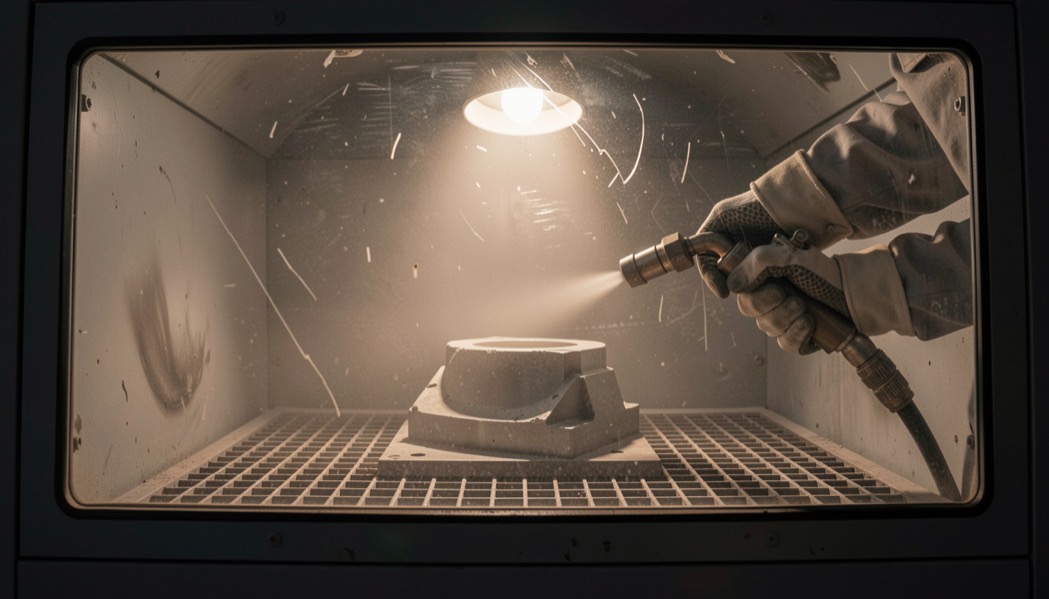
Abrasive blasting propels a stream of abrasive material against a surface under high pressure, to smooth a rough surface, roughen a smooth one, shape a part or strip contaminants. Benjamin Chew Tilghman patented the first process on 18 October 1870, and Thomas Wesley Pangborn added compressed air in 1904. On a finishing line the step sits in front of the bath, and it helps decide what the deposit has to hold on to.
From steel shot to baking soda
The public reference ranks the common media by how much they cut. Shot blasting with metal shot and sandblasting with sand are the most abrasive variants. Glass bead blasting and plastic media blasting sit in the middle, the latter fed with ground-up plastic stock, walnut shells or corncobs. Sodablasting with baking soda is mild, and ice blasting and dry-ice blasting are barely abrasive or nonabrasive. Two cautions travel with the ranking. The belief of the early 1900s, that sharp-edged grains performed best, was later shown to be incorrect. And some media cause anaphylactic shock in people allergic to them: the article’s cited news report concerns a worker with a walnut allergy who died after inhaling particles at a worksite.
Why would anyone add water to the abrasive?
Wet abrasive blasting uses water as the fluid moving the abrasives. The water traps the dust, lubricates the surface and cushions the impact, which reduces the removal of sound material under the contaminant. Norman Ives Ashworth was among the pioneers of the wet process in the late 1940s. Hot water and soap allow simultaneous degreasing and blasting, and the lack of recontamination lets stainless steel and mild steel parts run through the same equipment with the same media. The costs are speed and corrosion: with equivalent media wet blasting is generally slower than dry, and mild steel flash corrodes as soon as water touches the blasted face. Vapor blasting, air added to the water at the nozzle, is milder still, mild enough to clean mating surfaces while they keep their ability to mate, and wet systems answer parts that dry-blasting friction heat would damage.
Cabinets, pots, rooms and wheels
A blast cabinet is a closed loop of four parts, the containment, the blasting system, the abrasive recycling system and the dust collection. Siphon systems pull abrasive into the blast gun with a compressed-air vacuum; pressure systems meter it from a vessel pressurized to the same pressure as the hose. Portable rigs run on a diesel air compressor feeding blast pots, pressurized tanks that meter grit into the line, often mounted on semi-tractor trailers. Blast rooms are cabinets grown to fit rail cars and aircraft. Wheel blasting is airless: a spinning wheel throws recyclable steel or stainless-steel shot, a design first patented by Wheelabrator in 1932. Nozzle material follows the abrasive: boron carbide resists wear, tungsten carbide is the liner most used with mineral abrasives, and ceramic serves in smaller, inexpensive cabinets.
What the blast leaves behind
How much profile a surface gains depends first on the media. The Wikipedia article on sandblasting records that sandblasting tends to create a greater surface profile than bead blasting, one reason auto body work prefers beads, and that beads are often used to give machined parts a uniform finish. Mineral specimens of Mohs hardness 7 or less would be damaged by sand media and are cleaned with beads instead. At the small end, micro-abrasive blasting, also called pencil blasting, drives particles of 10 to about 150 micrometers through nozzles 0.25 to 1.5 mm in diameter, over areas from about 1 mm² to a few cm².
Why does silica dominate the safety record?
Because dust is what the process produces. The reference splits the media by hazard: steel shot, cast iron, aluminum oxide, garnet, plastic abrasive and glass bead are not hazardous in themselves, while silica sand, copper slag, nickel slag and staurolite carry free silica or heavy metals. Inhaling silica dust causes silicosis, and the first protective enclosure dates from 1918. OSHA in the United States mandates engineered solutions and still allows silica sand, even though the article notes that the most commonly used blast helmets are not sufficiently effective once ambient dust exceeds allowable limits; respiratory protection is approved by NIOSH, and the supplied air is Grade-D with a carbon monoxide monitor. The hazard is not abstract: in Turkey more than 5,000 textile workers who sandblasted worn-look jeans have silicosis, 46 are known to have died from it, and a 2015 study found the disease almost inevitable among former denim sandblasters.
Preparation is not cleaning chemistry
The two references assign this work differently. The electroless nickel reference is explicit: before plating the surface must be thoroughly cleaned, and unwanted solids left on the surface cause poor plating. That cleaning is a series of chemical baths, non-polar solvents for oils and greases, acids and alkalis for oxides and insoluble organics, with a thorough water rinse after each bath. Blasting removes contaminants mechanically; neither article presents it as a replacement for the bath sequence. The same reference adds that internal stresses in the substrate, created by machining or welding, can affect the plating, so a part can be clean and still plate badly. What sits in the bath, and how a surface is activated before the autocatalytic reaction will start, belongs to a separate note.
The number the public sources do not give
Neither article gives a roughness target. No profile height or surface-finish value appears in either reference; what they offer is comparisons, sand against bead, wet against dry. A specification that needs a number must look past these two pages. Silicon carbide works both sides of the line: on the blasting side it is a nozzle material that stands up to hard abrasives such as aluminum oxide, and on the plating side it is the hard composite deposit of the first commercial electroless nickel composite, applied on the Wankel engine. Powders suspended in the bath, from aluminum oxide to PTFE, are how composites and companion coatings are built. Before a batch leaves for the plater, put the media, the equipment class and its hazard list on the work order, and check that the cleaning sequence with its rinses is still in the routing.
Abrasive blasting before plating: the 2 sources used
- Wikipedia, Sandblasting · https://en.wikipedia.org/wiki/Sandblasting
- Wikipedia, Electroless nickel-phosphorus plating · https://en.wikipedia.org/wiki/Electroless_nickel-phosphorus_plating